Corrugated & ribbed metal panels
Corrugated and ribbed metal panels are usually the lowest-cost way to get a metal roof. They can be a practical choice for many homes, but they are not the right fit for every roof, budget, or neighborhood.
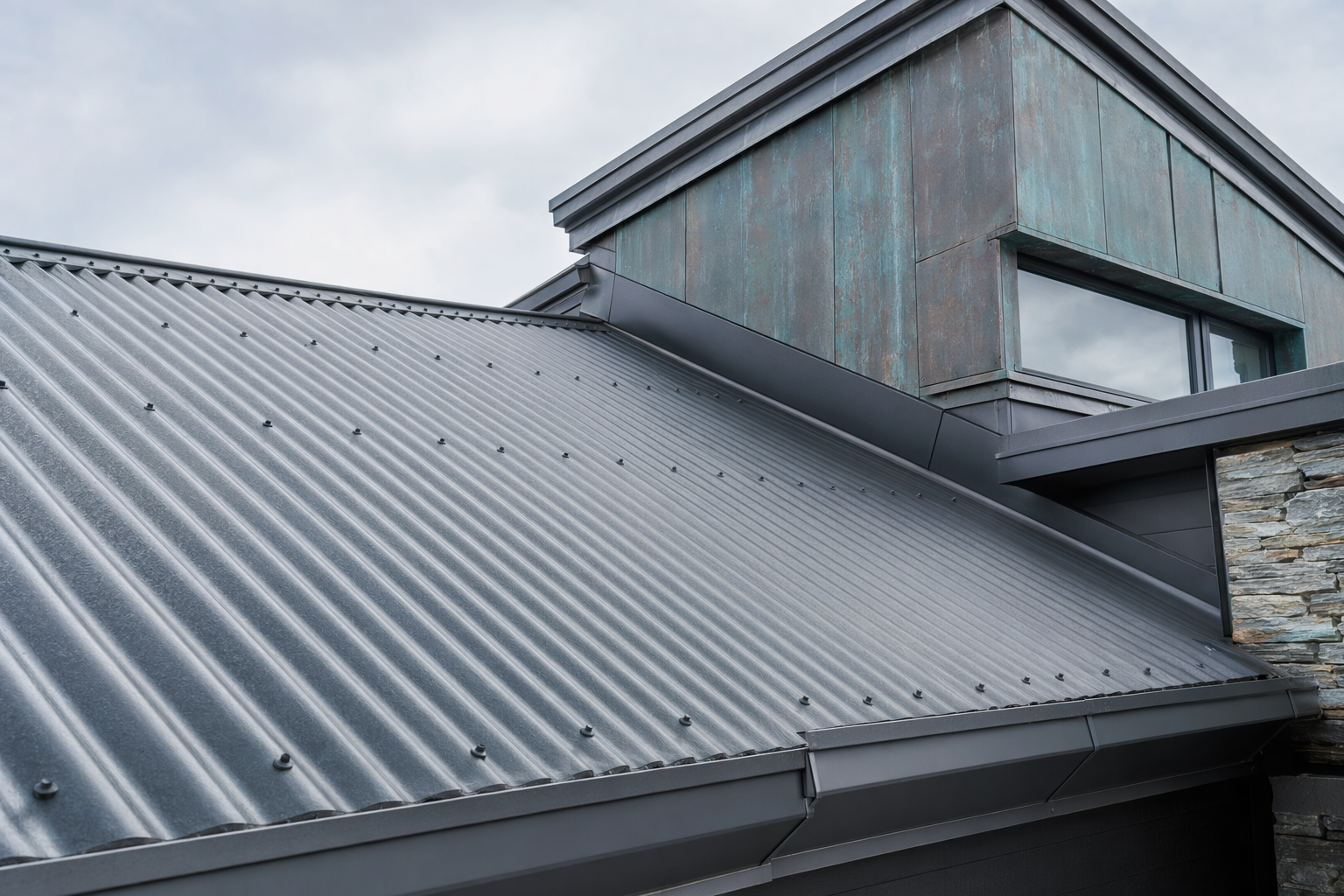
What corrugated and ribbed metal panels are
Corrugated and ribbed panels are exposed-fastener metal roofing systems. That means the screws are visible on the finished roof. The panels overlap each other, and the fasteners use rubber washers to help seal out water.
You will hear a few terms used like they mean the same thing:
- Corrugated usually means a wavy panel shape.
- Ribbed usually means raised vertical ribs or channels.
- Both are common, budget-friendlier metal panel options for homes, garages, sheds, barns, and some light commercial buildings.
For many homeowners, the main reason to look at this style is simple: it costs less than standing seam. If you want a metal roof but need to control the budget, this is often where the conversation starts. You can compare common metal options on our costs page or get matched with local roofers through our free service.
That said, cheaper up front does not mean better for every home. Some neighborhoods, HOA rules, roof shapes, and low-slope details may point you toward another system. A licensed roofer should look at your roof, local code, and the panel details before you decide.
How it works on a home
A corrugated or ribbed metal roof is usually installed in long panels from the eave up toward the ridge. The roofer fastens the panels to the roof deck or to a suitable underlayment assembly, depending on the system and local code. Trim pieces are used at ridges, hips, gable edges, valleys, chimneys, skylights, and wall transitions.
The basic process usually looks like this:
1. Inspection and measurements. The roofer checks roof size, pitch, penetrations, existing layers, and any problem areas.
2. Material selection. You choose the panel profile, metal type, gauge, coating, color, and trim package.
3. Tear-off or overlay decision. Some projects need a full tear-off. Others may allow installation over an existing roof if local code, manufacturer rules, and roof condition allow it.
4. Underlayment and flashings. These matter as much as the panels. A cheap panel on a poorly detailed roof can still leak.
5. Panel installation. The crew lays panels in sequence and installs screws at the required spacing.
6. Trim, sealants, and cleanup. Final details are where good and bad jobs often separate.
On a simple roof, these panels can go on faster than more complex metal systems. On a cut-up roof with many valleys, dormers, and penetrations, labor and waste go up, and the price can move closer to higher-end systems.
If you are comparing profiles, see our page on corrugated & ribbed options.
Typical cost range and what changes the price
For most homeowners, corrugated or ribbed metal panels typically run about $5-$9 per square foot installed. That is a normal ballpark, not a quote or guarantee.
Real price depends on:
- Roof size
- Roof pitch and complexity
- The metal and coating chosen
- Tear-off needs
- Your area
A simple one-story roof with easy access will usually cost less per square foot than a steep, complex roof with chimneys, skylights, valleys, or multiple existing layers to remove.
It also helps to compare it honestly with other roofing materials:
- Asphalt shingles: roughly $4-$8 per sq ft installed
- Corrugated/ribbed metal: roughly $5-$9 per sq ft installed
- Metal shingles: roughly $9-$14 per sq ft installed
- Standing seam: roughly $10-$18 per sq ft installed
So yes, metal usually costs more up front than asphalt. That is the truth. But metal also typically lasts much longer, often about 40-70 years, while asphalt is more often about 15-25 years. If you plan to stay put for a long time, the math may work in metal's favor. If you may move soon or your budget is tight right now, asphalt may be the smarter call. That is not failure. It is just matching the roof to your real situation.
For a side-by-side look, read metal vs asphalt.
Lifespan, maintenance, and where people get burned
A well-installed corrugated or ribbed metal roof can last around 40-70 years, but that is not automatic. Lifespan depends heavily on installation quality, climate, panel thickness, coating quality, ventilation, and maintenance.
Here is the honest part: exposed-fastener systems usually need more attention over time than concealed-fastener systems like standing seam. The screws and washers are working out in the weather year after year. Expansion, contraction, sun, wind, and age can eventually wear parts of that system.
That does not mean corrugated or ribbed panels are bad. It means you should go in with clear eyes.
Common maintenance items can include:
- Checking fasteners for backing out or washer wear
- Replacing damaged sealants at penetrations and trim
- Looking for panel damage after major storms
- Keeping debris out of valleys and transitions
- Watching for rust if protective coatings are damaged
The biggest homeowner mistakes are usually these:
- Choosing the lowest bid without checking panel specs
- Focusing only on panel price, not trim and flashing quality
- Not getting the metal type, gauge, coating, warranty, scope, and price in writing
- Hiring someone without verifying license and insurance
- Assuming all metal roofs are "lifetime" roofs with no upkeep
If you want a longer overview, our metal roof lifespan guide explains what affects service life.
Pros and cons for a homeowner
Pros
- Usually the lowest-cost entry point into metal roofing
- Often lighter than many other roofing materials
- Can last far longer than asphalt when properly installed
- Good choice for simple roof lines and accessory structures
- Available in many colors and finishes
- Faster installation on straightforward roofs
Cons
- Visible fasteners are a real maintenance factor over time
- Usually not as premium-looking as standing seam on many homes
- More chances for leak issues if trim, laps, or penetrations are done poorly
- Complex roofs can erase some of the cost advantage
- Some HOAs or neighborhoods may not like the look
- Noise concerns are often overstated, but insulation and assembly details matter
A plain truth: if your roof is architecturally complex and curb appeal matters a lot, standing seam or metal shingles may fit the house better. If you want a durable, practical metal roof at a lower price point, corrugated or ribbed panels may make good sense.
The goal is not to force metal onto every house. The goal is to understand the tradeoffs and compare real estimates from licensed roofers.
What to ask before you sign
When you talk to roofers, ask direct questions and get direct answers. You are trying to avoid vague promises.
Ask for these details in writing:
1. What exact panel profile are you proposing?
2. What metal is it made from, and what gauge is it?
3. What paint or protective coating is included?
4. What underlayment and flashing details will be used at valleys, chimneys, skylights, and walls?
5. Will there be a tear-off, and if so, how many layers?
6. Who is pulling permits, if permits are required?
7. What warranties apply to materials and workmanship?
8. What is excluded from the price?
9. How will damaged decking be handled if found after tear-off?
10. What is the payment schedule, and when is final payment due?
Also ask whether this roof system is a good fit for your home's slope and local weather. A trustworthy roofer should explain the strengths and limits of the system, not just push the panel they sell the most.
And always do the basics:
- Hire licensed, insured, bonded roofers
- Verify the license and insurance yourself
- Follow local permits and building code
- Keep copies of the signed scope, warranty documents, and product specs
- Hold final payment until the agreed work is complete
Our guide on how to vet a metal roofer can help you compare contractors more clearly.
How SeamRidge helps
SeamRidge is not a roofing company or installer. We are a free matching service that helps homeowners, including new immigrants and non-native-English speakers, understand their options and connect with licensed, insured, bonded metal roofers.
Here is how it works:
- You share basic project and contact details
- We help match you with participating roofers in your area
- You compare estimates, ask questions, and choose who to hire
- Matching is free to you
We do not decide the contractor for you. We do not set your project price. We do not promise that metal is always the best choice. Your job is to compare the written scope, materials, warranty terms, and total cost carefully.
If you are ready to start, use our free matching service.
In plain English
Corrugated and ribbed panels are usually the most affordable metal roof option. Get estimates from licensed, insured, bonded roofers, compare the exact panel specs and written scope, and choose the roof that fits your budget, how long you will stay, and your home's design.