Metal roofs & energy savings
A metal roof can help reduce summer heat gain, but it is **not** a magic bill-cutter on every house. The real result depends on the metal color, coating, attic insulation, ventilation, roof design, and your climate.
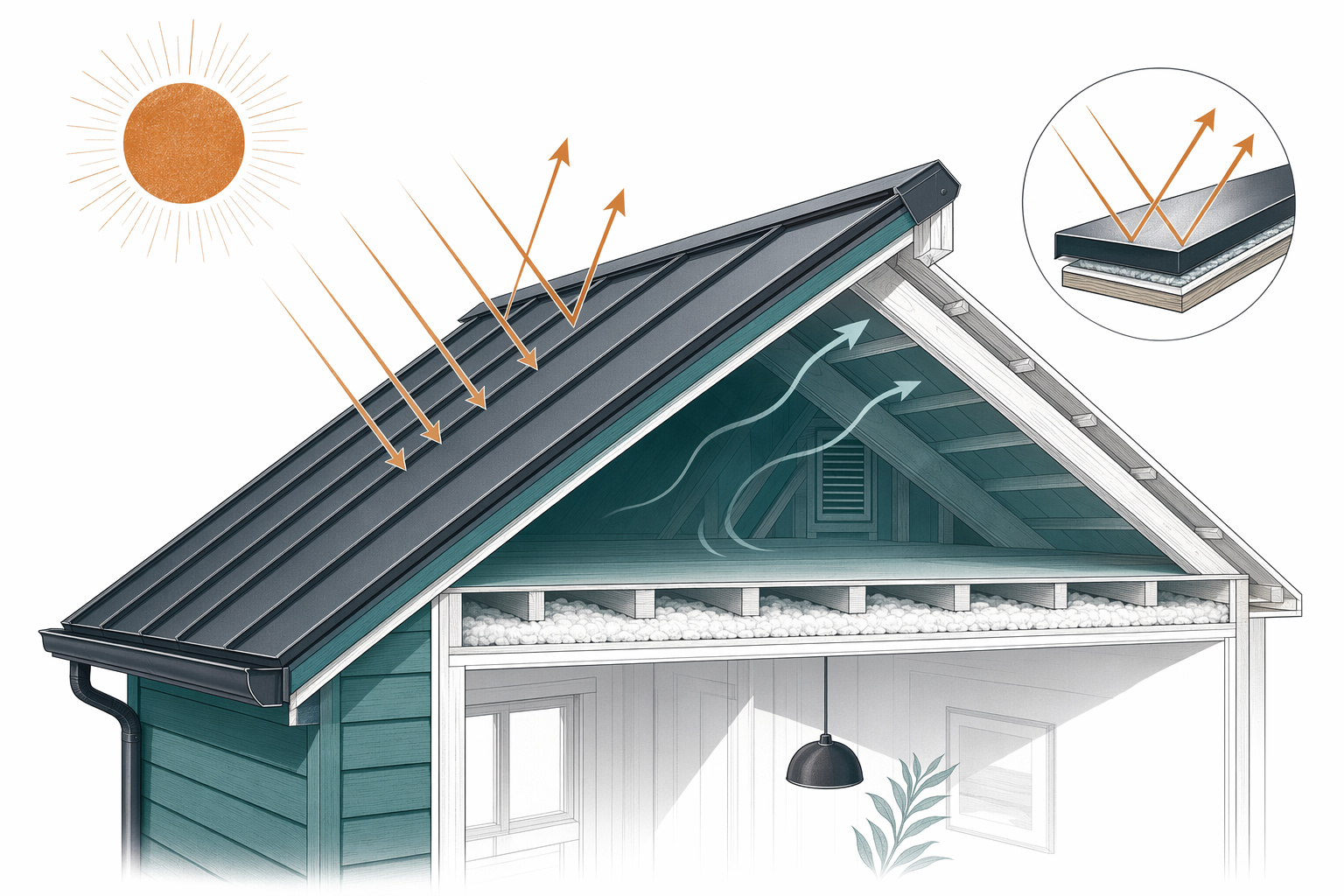
What energy savings from a metal roof really mean
When people say a metal roof is "more efficient," they usually mean it can reflect more solar heat than many dark, heat-absorbing roofs. That can help your attic and living space stay cooler in hot weather.
But the honest answer is simple: the roof alone does not decide your utility bill. Your home's energy use also depends on:
- attic insulation
- attic ventilation
- ductwork location
- air leaks around the house
- roof color and finish
- shade from trees
- local climate and sun exposure
A metal roof often performs best for energy savings when it has a lighter color or a reflective coating designed to reduce heat absorption. In a hot, sunny area, that can make a noticeable difference. In a mild or cold climate, the savings may be smaller.
It also helps to separate energy savings from overall value. Metal usually costs more up front than asphalt. Typical installed ranges are about $5-$9 per sq ft for corrugated or ribbed panels, $9-$14 for metal shingles, and $10-$18 for standing seam. Asphalt is often around $4-$8 per sq ft. Real price depends on roof size, pitch, the metal and coating chosen, tear-off, and your area.
So yes, energy performance can be part of the value. But the bigger long-term reasons many owners choose metal are often longer lifespan and lower maintenance risk over time. Learn more about durability in metal roof lifespan and cost ranges on our costs page.
Where metal roofs can help most
Metal roofing tends to help the most in homes that already have the basics in decent shape.
Good fit for energy savings:
- You live in a hot or mixed climate with strong summer sun.
- Your current roof is dark and holds heat.
- You are replacing the roof anyway, not changing it only for utility savings.
- You choose a reflective color or finish.
- Your attic insulation and ventilation are at least reasonably good.
Less dramatic payoff:
- You live in a mostly cold climate and spend more on heating than cooling.
- Your attic is under-insulated or poorly air-sealed.
- Your HVAC ducts leak into a hot attic.
- Large trees already shade most of the roof.
- You plan to sell soon and may not stay long enough to benefit from the higher upfront cost.
That last point matters. Asphalt may be the smarter call if your budget is tight or you expect to move in a few years. Metal often lasts about 40-70 years, while asphalt is commonly about 15-25 years. If you are staying long term, the math can look better for metal. If not, the cheaper roof may make more sense.
The style can matter too. A quality standing seam metal roof is often chosen for durability and clean lines. Corrugated and ribbed panels can be more budget-friendly. Metal shingles can fit neighborhoods where owners want a more traditional look.
What actually drives performance
A lot of homeowners focus only on the word metal. That is too broad. Two metal roofs can perform very differently.
Here are the main things to ask about:
1. Color
Lighter colors usually reflect more sunlight than darker colors. If your main goal is summer heat reduction, color matters.
2. Coating or paint system
The finish on the panels affects reflectivity and durability. Ask what coating is being offered and get it in writing.
3. Roof assembly
Underlayment, fastening method, venting details, and installation quality all affect how the roof performs in the real world.
4. Attic insulation and ventilation
If your attic is weak in these areas, a premium roof may not deliver the savings you expect. Sometimes upgrading insulation or sealing leaks gives a better payback.
5. Roof shape and exposure
A simple roof with full sun exposure may behave differently than a steep, shaded, complex roof with dormers and valleys.
6. Local weather
Hot, sunny areas usually see more cooling-related benefit than cool, cloudy areas.
This is why you should be careful with big promises like "cut your bill in half." Real homes do not work that way. A licensed roofer can explain the roofing system they propose, but they should not pretend the roof alone controls all energy costs.
If you want help comparing styles before you talk to contractors, see metal vs asphalt for a practical side-by-side view.
What to do before you decide
If energy savings are one reason you are considering metal, use this simple process.
1. Look at your whole house, not just the roof.
If your attic is under-insulated or your home leaks air badly, fix those issues first or at least factor them into your decision.
2. Decide your time horizon.
Are you staying 15+ years, or leaving soon? Metal's higher upfront cost is easier to justify for a longer stay.
3. Compare apples to apples.
Ask each roofer to list the exact metal type, gauge, panel profile, coating, underlayment, trim, ventilation details, warranty, scope of tear-off, cleanup, and total price.
4. Ask about reflective options.
If lowering summer heat gain is important, ask which colors and finishes are available and which are intended to reduce solar heat absorption.
5. Verify the contractor yourself.
Hire only licensed, insured, bonded roofers. Verify the license and insurance yourself. Follow local permit and code rules. A roofer should explain what permits are needed, but you should still confirm. Read our guide on metal roof permits.
6. Get multiple written estimates.
Do not rely on a handshake or a vague text message. You compare the estimates. You choose who to hire. You hold the final payment until the work matches the written scope.
SeamRidge can help you get matched with licensed, insured, bonded metal roofers at no cost to you. Matching is free for homeowners. Participating roofers pay a flat fee to be included.
Common mistakes that lead to disappointment
Most frustration comes from bad expectations, not just bad materials.
- Expecting the roof to fix insulation problems. A reflective roof can help, but it will not make up for major attic insulation or air sealing issues.
- Buying on price alone. The cheapest bid may leave out coating details, tear-off, trim, or ventilation work.
- Not checking credentials. Always verify license and insurance yourself. Do not assume.
- Ignoring written specs. Get the metal type, gauge, coating, warranty, scope, and price in writing before any deposit.
- Confusing durability with instant savings. Metal can be a strong long-term choice without producing dramatic monthly utility savings.
- Choosing the wrong roof for your situation. If money is tight and you need the lowest upfront cost, asphalt may be the practical answer.
A good roofer should be able to explain the tradeoffs plainly. If someone avoids specifics or makes huge savings promises, slow down.
Before hiring anyone, use our checklist to vet a metal roofer.
The bottom line for homeowners
A metal roof can help reduce cooling demand, especially in hot climates and with the right color and coating. It also often brings a longer service life than asphalt. But it costs more up front, and the real-world energy result depends on more than the roofing material.
The smart move is to treat metal as part of a whole-house decision. Compare lifespan, upfront cost, appearance, maintenance expectations, and likely time in the home. Then get written estimates from licensed, insured, bonded roofers and verify their credentials yourself.
If you want to explore options without pressure, SeamRidge can help you compare local metal roofing pros for free.
In plain English
Metal roofs can help with summer heat, but the savings are not automatic. Compare the higher upfront cost with your budget, how long you will stay, and the condition of your attic, then get written estimates from licensed, insured, bonded roofers and verify them yourself.