Standing Seam vs Corrugated Metal Roofing
Both are real metal roofs, but they are not the same product. **Standing seam usually costs more and looks cleaner. Corrugated usually costs less and can still last a long time** when installed right.
The short answer
If you want the simple version, here it is:
- Choose standing seam if you want a cleaner, more modern look, fewer exposed fasteners, and you plan to stay in the home a long time.
- Choose corrugated or ribbed panels if budget matters more, you like the panel look, and you understand that exposed-fastener systems usually need more attention over time.
- Choose asphalt instead if you may move soon or your budget is tight. Asphalt is usually cheaper up front, often about $4-$8 per sq ft installed, while metal typically costs more but may last much longer.
Typical installed ranges for metal:
- Corrugated/ribbed: about $5-$9 per sq ft
- Standing seam: about $10-$18 per sq ft
Those are typical estimates, not quotes. Real price depends on roof size, pitch, tear-off, trim details, the metal and coating chosen, and your area. If you want a broader cost breakdown, start here: metal roof costs and metal vs asphalt.
For lifespan, both can outlast asphalt when the right system is used and the installation is done well. In general, metal roofs often last about 40-70 years, while asphalt often lasts about 15-25 years.
What makes these two roofs different
The biggest difference is how the panels handle seams and fasteners.
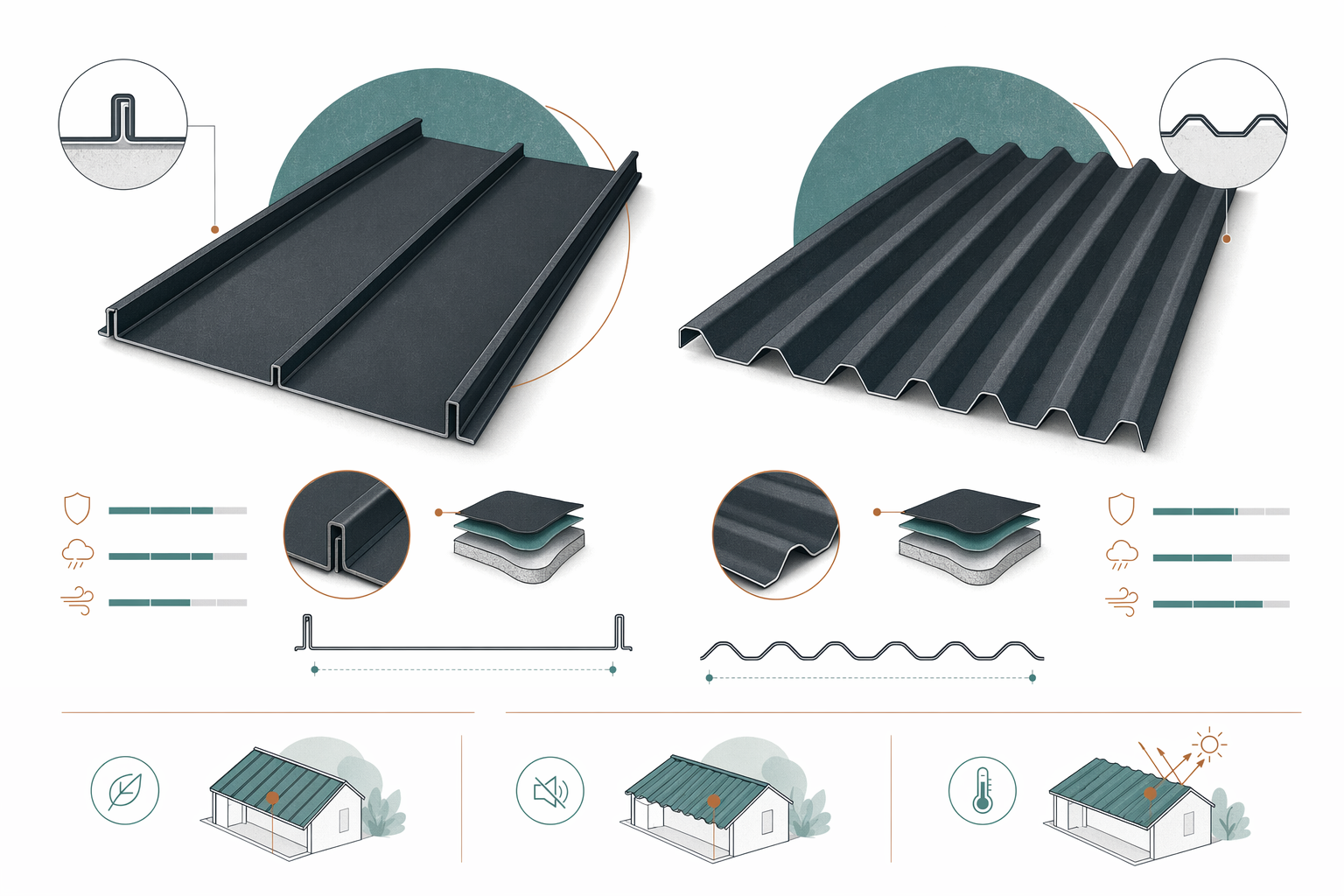
Standing seam panels have raised seams that lock together. In many systems, the fasteners are hidden under the seams instead of exposed on the face of the panel. That cleaner design is a big reason homeowners choose it.
Corrugated or ribbed panels have visible waves or ribs. In many residential systems, screws go through the face of the panel with washers at each fastener point. That is one reason corrugated is often less expensive.
Why this matters:
1. Appearance
Standing seam usually looks smoother and more finished. It is common on newer homes, modern farmhouses, and higher-end remodels. Corrugated has a more rugged, agricultural, cabin, or utility look, though some homeowners like that style.
2. Water management
With standing seam, the seams are raised and many fasteners are concealed. With corrugated, many systems rely on exposed fasteners and overlapping panels. Both can perform well, but details matter more than marketing words.
3. Maintenance
Exposed-fastener roofs may need more periodic attention because screws and washers can age, loosen, or back out over time. Standing seam is not maintenance-free, but many homeowners choose it partly to reduce those common exposed-fastener issues.
4. Expansion and contraction
Metal moves as temperatures change. Good standing seam systems are often designed to handle that movement well. On lower-cost panel systems, movement can put more stress on fasteners and penetrations if the system or installation is not right.
This does not mean corrugated is bad. It means the lower price often comes with tradeoffs you should understand before you sign.
Cost, lifespan, and where people get burned
Homeowners usually compare these roofs for one reason: money now versus money later.
Standing seam usually costs more up front. That part is true. It can be a smart long-term buy, but not for every household.
Typical installed ranges:
- Corrugated/ribbed metal: about $5-$9 per sq ft
- Standing seam metal: about $10-$18 per sq ft
- Asphalt shingles: about $4-$8 per sq ft
Again, those are typical estimates. Your actual project depends on:
- roof size and complexity
- pitch and height
- tear-off and disposal
- underlayment and flashing details
- metal type, thickness/gauge, and paint/coating system
- trim, valleys, chimneys, skylights, and penetrations
- local labor rates and permit requirements
Lifespan:
- Metal roofs often last around 40-70 years
- Asphalt roofs often last around 15-25 years
That longer metal lifespan is real, but you still should not assume the most expensive roof is automatically the right buy.
When asphalt may be the smarter call:
- You may sell the home soon.
- You need the lowest upfront cost.
- Your house value or neighborhood does not support the premium.
- The roof structure, trim work, or details would make metal unusually expensive.
Where people get burned on metal:
- They compare one bid with cheap exposed-fastener panels to another with a better concealed-fastener system and think they are equal.
- They do not ask for the metal type, gauge, coating, trim scope, underlayment, and warranty in writing.
- They focus only on the panel price and ignore tear-off, flashing, penetrations, and edge details.
- They hire an unlicensed crew because the price is lower.
Before you put down a deposit, get clear on exactly what system you are buying. If you want more detail on expected service life, see metal roof lifespan.
How to choose for your house
A good choice depends on your home, your budget, and how long you expect to stay.
Standing seam is often the better fit if:
- You want a cleaner residential look.
- You expect to stay put for many years.
- You want to avoid the look of exposed screws.
- Your roof has enough complexity that better seam and flashing details matter.
- You are comfortable paying more up front for a longer-term system.
Learn more here: standing seam metal roofing.
Corrugated or ribbed is often the better fit if:
- You want metal but need to control cost.
- Your roof is simpler and easier to panel.
- You like the visual style.
- You understand that exposed-fastener systems may need more maintenance over time.
More here: corrugated and ribbed metal roofing.
Questions to ask yourself first:
- How long will I live here?
- Is lower upfront cost more important than lower long-term replacement frequency?
- Do I care more about clean appearance or lowest price?
- Am I comparing the same metal type, gauge, coating, and trim package on each estimate?
If your answer is "I want the best-looking long-term system I can afford," standing seam often wins. If your answer is "I want a practical metal roof without the highest premium," corrugated may be the better match.
What to do next before you hire anyone
Use this checklist. It can save you a lot of trouble.
1. Get at least two or three written estimates.
Make sure each one lists the panel type, metal type, gauge, coating/finish, underlayment, flashing scope, trim, warranty, and cleanup.
2. Verify the roofer yourself.
Hire licensed, insured, bonded roofers where required, and verify license and insurance yourself before any deposit.
3. Ask about permits and code.
Your project may need permits or specific installation details under local code. Read: metal roof permits.
4. Do not rely on vague storm promises.
If your roof has storm damage, work with your own insurer and a licensed roofer. No one can honestly guarantee a claim result or promise coverage.
5. Compare apples to apples.
A low number is not a bargain if key flashings, tear-off, or trim are missing.
6. Hold final payment until the agreed work is done.
You compare estimates, you choose who to hire, and you hold the final payment until the scope is complete.
If you want help finding roofers to compare, SeamRidge can connect you with participating contractors at no cost to you. We are a free matching service, not a roofing company or installer. You can start here: get matched or read our guide on how to vet a metal roofer.
In plain English
If you want the cleaner, more premium metal roof and can afford the higher upfront cost, standing seam is often the better long-term choice. If you want a lower-cost metal roof and accept more visible fasteners and possible maintenance later, corrugated may fit better. Get written estimates, verify license and insurance yourself, and compare the exact system details before you pay a deposit.