What a roofing contract should include
A roofing contract is where good promises become real details. If the metal type, gauge, coating, scope, warranty, permits, cleanup, and payment terms are not in writing, you are taking a risk.
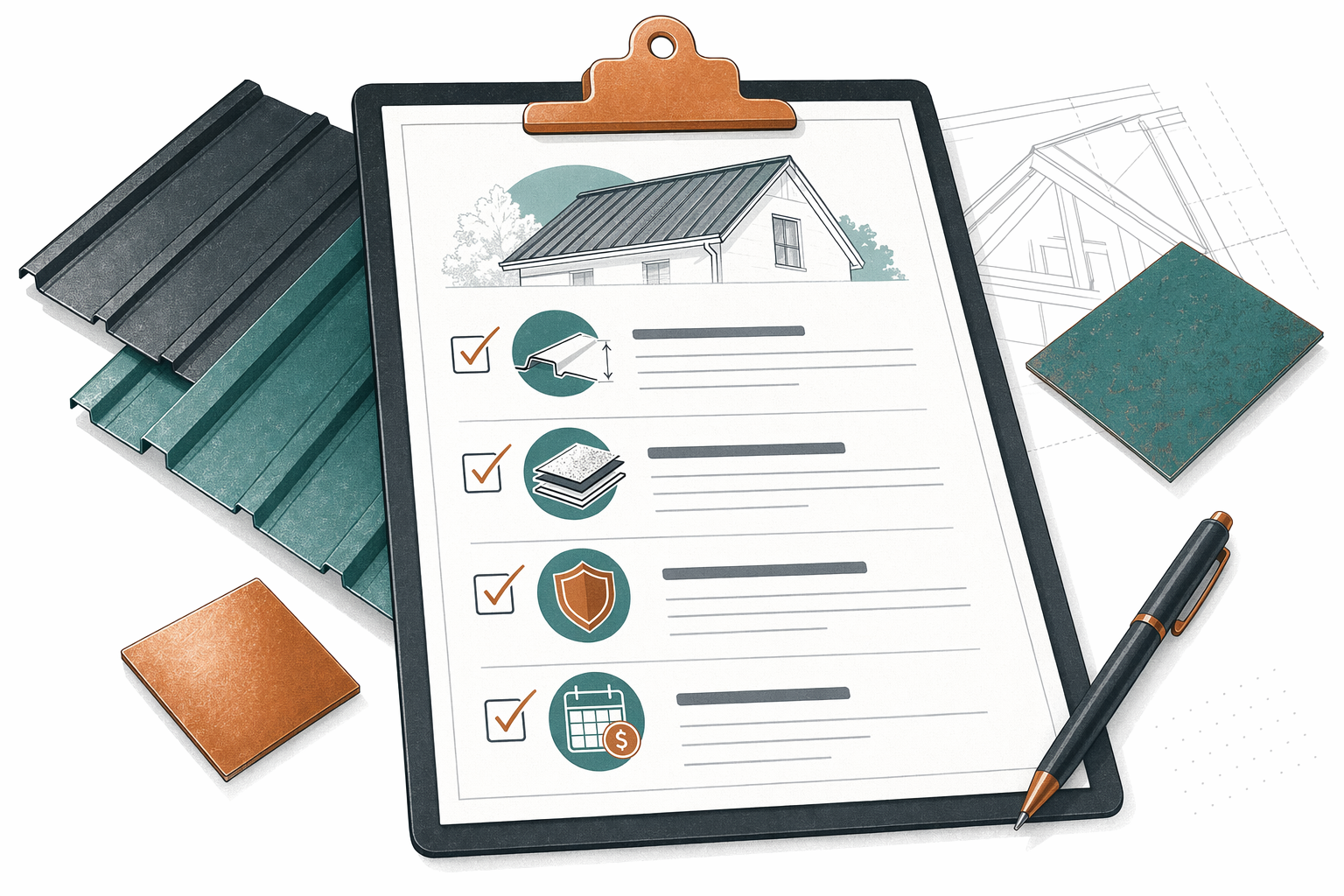
Why the contract matters more than the sales talk
A clear contract protects you and the roofer. It reduces confusion, helps you compare one bid to another, and gives you something concrete to check before work starts.
This matters even more with metal roofing because the final price can change a lot based on the panel style, metal thickness, coating, trim work, tear-off, underlayment, and local labor. A metal roof usually costs more up front than asphalt, but it also typically lasts much longer — about 40-70 years for metal versus 15-25 years for asphalt. Typical installed ranges are about $5-$9 per sq ft for corrugated or ribbed panels, $9-$14 per sq ft for metal shingles, $10-$18 per sq ft for standing seam, and about $4-$8 per sq ft for asphalt. Those are estimates, not quotes. Your real price depends on roof size, pitch, tear-off, the metal and coating chosen, and your area.
If you plan to move soon or your budget is very tight, asphalt may be the smarter choice. If you want longer life and are prepared for the higher upfront cost, metal may make sense. A contract helps you see what you are truly paying for. You can also review general costs before you compare proposals.
The core items every roofing contract should list
At minimum, the contract should spell out who is doing the work, what materials will be used, what work is included, what it costs, and what happens if something changes.
Look for these basics:
- Contractor legal name and contact info: not just a salesperson's cell number.
- License and insurance details: ask for the license number and proof of liability and workers' compensation insurance. Hire only roofers who are licensed, insured, and bonded, and verify that yourself.
- Property address: the exact job site.
- Detailed scope of work: tear-off or overlay, decking repairs if needed, underlayment, flashing, ventilation-related work if included, trim, pipe boots, valleys, ridge details, and cleanup.
- Material specifications: this is a big one on metal jobs. The contract should list the metal type, panel/profile, gauge or thickness, paint/coating system, color, and trim/accessory details.
- Brand or equivalent language: if a specific manufacturer is promised, it should be named. If substitutions are allowed, that should be stated clearly.
- Estimated start and completion timing: weather can delay roofing, but the contract should still give a reasonable timeline.
- Permit responsibility: who pulls permits and who schedules any required inspections. Local permit and code rules matter, so make sure the contract follows them. See metal roof permits if you want a quick overview.
- Payment schedule: deposit, progress payments if any, and final payment terms.
- Warranty terms: both workmanship and manufacturer material warranty, with limits and exclusions.
- Change-order process: how extra work is approved and priced.
- Cleanup and disposal: old roofing, nails, dumpsters, magnetic sweep, and who is responsible for hauling debris.
For metal roofs, vague wording is a red flag. "Install new metal roof" is not enough.
What metal-roof details should be in writing
This is where many homeowners get burned. Two metal roofs can look similar from the street but perform very differently.
Make sure the contract names the exact system you are buying, such as standing seam, exposed-fastener corrugated/ribbed panels, or metal shingles. Then check these details:
1. Panel style and attachment method
- Standing seam and exposed-fastener systems install differently and have different price ranges and maintenance needs.
- The contract should say what profile is being used and how it is fastened.
2. Gauge or thickness
- Heavier is not always necessary for every home, but the promised gauge should be written down.
- Do not rely on verbal statements like "commercial grade" without a number.
3. Coating and finish
- The paint/coating system affects fade, chalking, and corrosion resistance.
- Ask for the coating type and color in writing.
4. Underlayment and flashing
- The contract should list the underlayment type and where flashing will be replaced or reused.
- Chimneys, skylights, valleys, sidewalls, and penetrations should be addressed.
5. Trim and accessories
- Ridge caps, eave trim, rake trim, snow retention if included, sealants, closures, and pipe boots should not be left to guesswork.
6. Decking repairs
- Rotten sheathing often is not fully known until tear-off. The contract should explain how damaged decking will be priced if found.
7. Warranty language
- Get the workmanship warranty term in writing.
- Get the manufacturer warranty name or document if one applies.
- Read exclusions. Improper ventilation, coastal exposure, foot traffic, and ponding issues may affect coverage depending on the product and roof design.
If the roofer cannot explain these items in simple words, slow down. You can learn the main system differences on our services pages before you sign anything.
How to review the payment terms and change orders
A fair contract should make payment simple and traceable. It should also keep surprise charges under control.
Use this checklist:
- Deposit amount: it should be stated clearly. Be cautious if the deposit feels very large for your market.
- Progress payments: if there are any, they should tie to real milestones, not vague promises.
- Final payment: hold final payment until the work is substantially complete, cleanup is done, and you have the paperwork promised.
- Accepted payment methods: keep a paper trail.
- Change orders in writing: if hidden damage or extra work appears, the roofer should explain the reason, the added cost, and the effect on timing before proceeding where practical.
- No blanks: never sign a contract with blank spaces that can be filled in later.
If the project involves storm damage, stay careful with insurance talk. A roofer may help document roof conditions, but no one can promise claim approval or coverage. Work with your own insurer and a licensed roofer, and make sure any contract language about supplements, allowances, or owner responsibility is clear before you sign.
Also, do not let anyone rush you into signing "today only" terms. A real professional will give you time to read, ask questions, and compare estimates.
Common contract mistakes homeowners make
Most contract problems start before the first shingle or panel comes off. Here are the mistakes to avoid:
- Choosing by lowest price alone. A lower number may mean thinner metal, fewer accessories, less tear-off, reused flashing, or weak cleanup terms.
- Assuming all metal roofs are the same. They are not. Standing seam, metal shingles, and exposed-fastener panels differ in cost, look, and details.
- Not verifying license and insurance. Ask for proof and check it yourself.
- Trusting verbal promises. If it matters, put it in writing.
- Ignoring exclusions. Decking replacement, permit fees, gutter work, skylight work, and interior damage are often excluded unless listed.
- Overlooking warranty limits. A long material warranty does not replace a solid workmanship warranty.
- Paying too much too early. Keep control of the final payment.
- Skipping permit questions. Unpermitted work can create problems later when you sell or file paperwork.
One more honest point: if you compare metal to asphalt and decide asphalt fits your budget and timeline better, that is okay. The right contract for an asphalt roof should still include the same basics. If you are weighing the tradeoffs, review metal vs asphalt.
What to do before you sign
Take these steps in order:
- Get at least two or three written estimates so you can compare scope, not just price.
- Read line by line and circle vague words like "as needed," "standard," or "upgrade" if they are not explained.
- Ask for the exact metal type, gauge, coating, color, underlayment, trim, and warranty documents.
- Verify license, insurance, and bond information yourself.
- Confirm permit responsibility and ask whether inspections are required in your city or county.
- Make sure change orders must be approved in writing.
- Do not pay the full amount up front.
- Keep copies of the signed contract, proof of insurance, permit records, product info, and receipts.
If you want help finding roofers to compare, get matched with licensed, insured, bonded metal roofers through SeamRidge at no cost. Matching is free for homeowners. You compare estimates, you choose who to hire, and you hold the final payment.
In plain English
Before you sign, make sure the contract clearly lists the roofer's license and insurance, the exact metal system and materials, the full work scope, permits, cleanup, warranty, payment schedule, and how changes are approved. Get it all in writing, verify the roofer yourself, compare estimates, and do not pay in full up front.